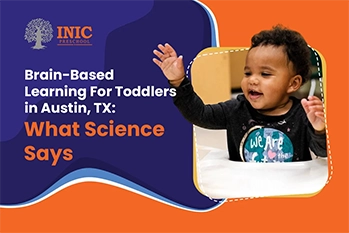
Brain-based learning for toddlers in Austin, TX, focuses on practices that align with how young brains grow: rich language, movement, sensory exploration, and secure relationships. During ages one to three, neural pathways strengthen through repeated, joyful experiences that connect emotion with new skills.
All INIC Preschool age groups including babies, toddlers, preschool, and pre-kinder benefit from our specialized brain-based learning curriculum. Classrooms at our Austin, TX and Round Rock campuses pair hands-on play with intentional instruction to help children build attention, self-regulation, and early problem-solving. Daily routines like songs, stories, and outdoor exploration reinforce memory and language. When teachers observe closely, introduce just-right challenges, and partner with families, toddlers gain the foundations for curiosity, persistence, and social confidence that carry into preschool and beyond.
Neuropsychological Toddler Education: Principles That Guide Practice
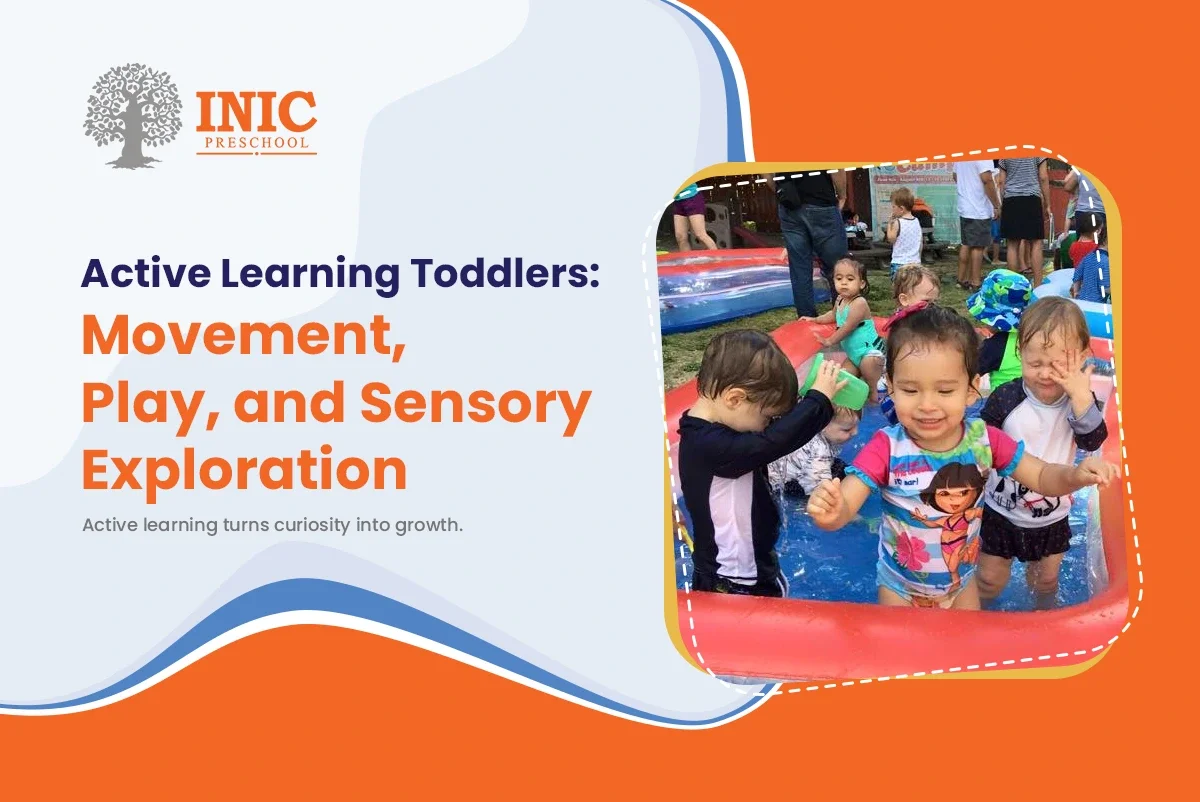
Toddlers learn with their whole bodies and hearts. Brain-smart classrooms weave secure relationships, movement, language, and playful challenge into every routine so curiosity and stress stay low. Here’s how that looks in action.
Secure Relationships Power Attention
Trust is the first curriculum. Teachers greet by name, mirror feelings, and co-regulate with simple breaths or a short song. Predictable rituals lower cortisol, opening the door for focus, imitation, and risk-taking with new tasks.
- Warm hellos and visual schedules
- Comfort strategies modeled in the moment
- Consistent caregiver pairings for continuity
Attention Works in Rhythms, Not Marathons
Young brains learn best in short, repeatable cycles: brief modeling, hands-on try, quick feedback, reset. Novelty appears in small doses while familiar routines anchor the day.
- Brief mini-lessons, then explore
- “See it → Try it → Name it” loops
- Timers, chimes, and picture cues for smooth transitions
Movement and Sensory Input Wire New Skills
Gross and fine motor play for toddlers drive language, planning, and self-control. Teachers pair action words with bodies in motion and offer tactile materials that invite comparison and problem-solving.
- Climb, carry, pour, and scoop to build planning
- Finger gyms: stickers, tongs, dough, crayons
- Sensory labs (water, sand, seeds) for cause-and-effect
Repetition With Variation Builds Memory
Joyful repeats strengthen pathways, and tiny twists keep curiosity alive. Stories return with a new prompt, songs add a verse, and block challenges swap materials.
- Spaced practice across the week
- Retrieval cues (“What comes next?”)
- Portfolios with photos, child dictation, and samples
Language Nutrition Grows Social Thinking
Rooms hum with rich talk: describe, expand, invite. Teachers model turn-taking scripts and feeling words so children can solve problems with peers.
- Parallel talk links words to actions
- Open questions: who, what, where, why
- Picture cues and gestures to boost comprehension
Observation Personalizes Tomorrow
Daily notes turn into targeted setups: vertical drawing for shoulder strength, more category words at snack, and an extra calm corner near blocks.
- Quick checklists and anecdotal notes
- Tiny goals shared with families
- Adjusted materials to keep the challenge “just right”
Result: a steady, joyful climb in attention, language, self-regulation, and problem-solving—because the classroom is tuned to how the toddler brain grows.
How Toddlers Process Information: Attention, Memory, and Emotion

Toddler brains take in the world in short, powerful bursts. Learning sticks when experiences are emotionally safe, repeated across the day, and presented through movement, language, and play. This section explains the science in family-friendly terms you can spot during a classroom visit.
Attention: Short Cycles, Clear Signals
Young learners focus best in brief, rhythmic blocks that alternate between modeling and hands-on exploration. Teachers reduce clutter, preview what is next, and use signals that are easy to follow.
- Mini-lessons of 2–5 minutes
- Visual schedules and simple timers
- One-step directions that grow to two-step directions
Working Memory: Hold It, Use It, Say It
Working memory lets toddlers keep a small idea in mind while acting. Classrooms strengthen it by pairing language with action, then inviting quick recall.
- “Say and do” routines: “Two blocks, then a roof”
- Songs with gestures to rehearse sequences
- Clean up maps that match picture labels to shelves
Long-Term Memory: Repetition With Meaning
Long-term memory grows when experiences repeat across contexts and feel emotionally positive. Teachers revisit stories, games, and materials, adding small twists to keep curiosity high.
- Story re-reads with a new prompt
- Matching games that rotate images and categories
- Center invitations that echo the week’s theme
Emotion: The Gatekeeper of Learning
Emotion determines whether attention opens or shuts down. Predictable routines and supportive coaching help children name feelings and return to calm, which allows thinking to resume.
- Cozy corners with soft visuals and breathing cues
- Feeling charts paired with simple scripts
- Teacher narration that normalizes big feelings
Processing in Motion: Bodies Lead the Brain
Toddlers remember more when their bodies are involved. Movement binds new vocabulary to real actions and gives the brain repeated sensory input to sort and store.
- Action words practiced during climbing and carrying
- Finger gyms for pincer grasp, turn-taking, and patience
- Outdoor exploration that links nature words to discoveries
What To Look For On a Tour
You should see short learning bursts, clear transitions, and teachers who pair words with actions. Materials reappear across the week, emotions are coached in the moment, and children practice recalling steps. That is how attention, memory, and emotion work together to build understanding.
Active Learning Toddlers: Movement, Play, and Sensory Exploration
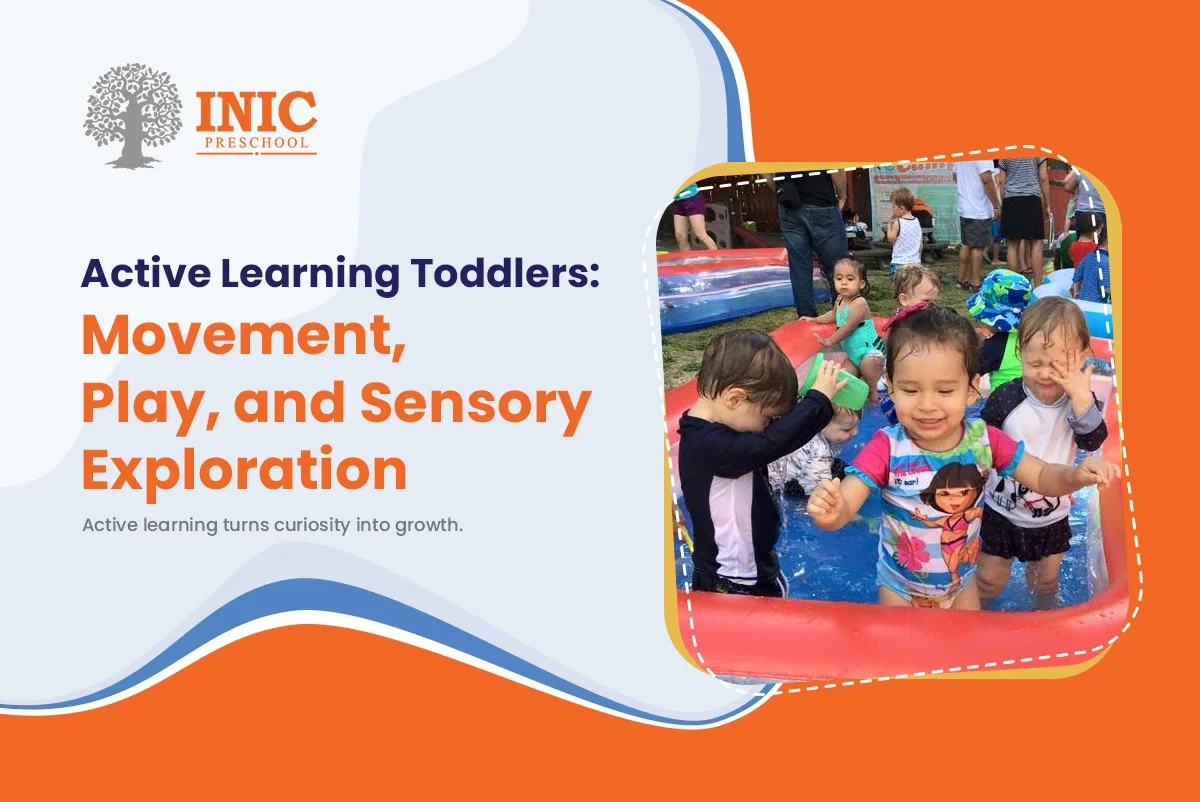
Active learning turns curiosity into growth. When toddlers move, explore textures, and role-play with peers, the brain links new vocabulary to real experiences, building attention, memory, and self-control.
Movement Powers Thinking
Big-body play is more than “getting the wiggles out.” Climbing, carrying, crawling through tunnels, and pushing carts develop balance and core strength that support posture for seated tasks.
Teachers pair action words with motion so language and motor pathways grow together. Simple obstacle courses add sequencing: first steps, then a tunnel, then a target toss, helping children keep steps in mind and persist through challenges.
Purposeful Play Builds Problem-Solving
Dramatic play and block centers are laboratories for planning and negotiation. Children assign roles, gather materials, and test ideas; teachers model scripts such as “Can I have a turn after you?” and “Let’s try a different piece.”
Small-group invitations introduce just-right puzzles: matching lids to containers, building bridges that hold two toy animals, or sorting by color and size. These tasks strengthen reasoning without pressure, encouraging flexible thinking and teamwork.
Learn more about Purposeful Play for toddlers here.
Sensory Exploration Wires Concepts
Hands-on materials, like water, sand, seeds, dough, and fabric scraps, give the brain the varied input it needs to notice patterns. Educators scaffold comparisons: heavy/light, rough/smooth, sink/float.
Fine-motor trays with tongs, tweezers, stickers, and crayons build pincer grasp and hand strength for later writing. Sensory play also supports regulation; steady scooping, pouring, and kneading can calm big feelings while keeping learning active.
Integrating Across the Day
Active learning works best in short cycles. Teachers alternate brief modeling with child exploration, then gather quick reflections: “What helped your tower stand?” Visual timers, picture cues, and tidy paths between centers prevent crowding and keep transitions smooth. Outdoors, staff plan for heat, shade, hydration, and safe risk-taking so gross-motor goals continue beyond the classroom walls.
What To Look For On a Tour
- Rotating movement pathways with clear safety rules
- Dramatic play stocked with real-world props and labels
- Sensory bins with defined tools, cleaning routines, and vocabulary cards
- Fine-motor trays that change weekly to match classroom themes
- Teachers narrating actions, modeling social scripts, and celebrating effort
Result: a joyful, purposeful day where bodies lead the brain, play carries the curriculum, and sensory discovery makes ideas stick.
Language-Rich Environments: Conversations, Stories, and Music
Words grow where talk is natural, joyful, and everywhere. Language is not a “lesson” in toddler rooms—it is the soundtrack of play, caregiving, and discovery from arrival to goodbye.
Conversations: Talk That Tracks the Moment
Teachers narrate what children see, feel, and do: “You’re rolling the blue truck up the ramp.” Parallel talk connects vocabulary to action, while expansions turn short phrases into full ideas. Two-way exchanges are frequent and brief, honoring toddler attention and giving many chances to practice sounds, words, and turn-taking. Visuals keep comprehension strong without stopping the flow.
Stories: Repetition With a Twist
Books return daily, but the prompt changes. Monday might spotlight actions (“Who hops?”). Wednesday invites prediction (“What do you think happens next?”). Friday adds retelling with props or photo cards. This “repeat, then vary” rhythm builds background knowledge, story grammar, and memory. Small-group activities let teachers tune questions to each child’s language level and celebrate emerging sounds and new words.
Music: Rhythm as a Language Engine
Songs compress rich language into patterns toddlers can feel. Call-and-response chants strengthen attention and listening; fingerplays build sequencing and fine-motor control; movement songs pair verbs with action so vocabulary sticks. Teachers weave music into transitions so practice happens many times a day without pressure. Instruments and simple beats introduce tempo, fast/slow contrasts, and shared turn-taking.
Teacher Moves That Multiply Words
- Name–Action–Feeling: “Maya stacked three blocks. You look proud.”
- Expand + Model: Child: “Dog run!” Teacher: “Yes, the brown dog is running fast.”
- Wait Time: Count to five after a question to invite a reply.
- Spotlight Peers: “I heard Jimmy say ‘another scoop.’ Who will try that word?”
What To Look For on a Tour
You should hear warm commentary about children’s actions; see labeled shelves and picture schedules; notice familiar books revisited with new prompts; and feel music guiding routines. Children are invited to answer, imitate, and retell, and teachers capture moments that feed tomorrow’s conversations, stories, and songs.
Conclusion
Brain-based learning occurs when toddlers move, explore, and talk their way through each day. Short, predictable routines pair with rich conversations, stories, and music so new vocabulary connects to real experiences. Teachers observe closely, adjust materials, and celebrate small steps, which keeps the challenge at the right level and increases confidence. On your visit, look for calm rhythms, active play with purpose, and teachers who model language during every routine. Ask how progress is documented and how families can extend strategies at home. When the environment feels safe, joyful, and intentional, the science of early learning becomes visible in every moment.
Ready to see brain-based learning in action at INIC Round Rock? Call (512) 435-7868 or schedule a tour at https://inic-edu.com/contact-tours.
Experience the INIC Difference: The Best Spanish immersion Preschool & Daycare
Learn. Play. Make Friends. Founded in 2012, INIC Preschool & Daycare (International Immersion Center) is a Spanish immersion school with locations in Round Rock and South Austin. Educators here are upbeat and enjoy a positive teacher-led work environment with access to many benefits. INIC’s evidence-based curriculum emphasizes social-emotional learning, math, reading, Dynamic Movement, Purposeful Play, and Creative Lab Arts for babies, toddlers, preschool, pre-k 3, and pre-k 4. The classroom experience is intentionally low tech for kids, but parents and grandparents are delighted to check in on their little scholar with high-tech, easy-to-use tools: WatchMeGrow and Brightwheel. All classes and activities are taught in Spanish, every day, as well as Mandarin Chinese. It’s much more than a daycare.
INIC Preschool Round Rock proudly serves families in Pflugerville, North Austin, Cedar Park, Leander, Georgetown, Hutto, Taylor, and Liberty Hill. INIC Preschool South Austin has served these communities since 2012: South Austin, Circle C, Oak Hill, Buda, Kyle, Dripping Springs, Driftwood, Bee Cave Township, Westlake, Onion Creek, Manchaca, and more.
Round Rock area: 2960 Jazz Street, Round Rock, Texas 78664 [email protected]
South Austin: 2100 W. William Cannon Dr., Austin, Texas 78745 [email protected]